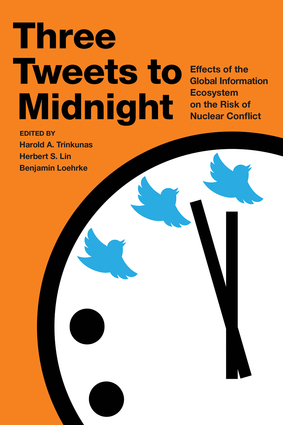

Three Tweets to Midnight
Effects of the Global Information Ecosystem on the Risk of Nuclear Conflict
POLITICAL SCIENCE
248 Pages, 6 x 9
Formats: Paperback, ebook: EPUB, ebook: PDF, Mobipocket
Paperback, $34.95 (US $34.95) (CA $46.95)
Publication Date: March 2020
ISBN 9780817923358

Overview
Can social media trigger nuclear war? In our “post-truth” era of bots, trolls, and intemperate presidential tweets, popular social platforms provide a growing medium for manipulation of information directed to individuals, institutions, and global leaders. Targeted influence campaigns have been waged in at least forty-eight countries so far. This volume examines the current reality from a variety of angles, considering how digital misinformation might affect the likelihood of international conflict and how it might influence the perceptions and actions of leaders and their publics before and during a crisis.- Examine the impact of social media on nuclear conflict risk
- Minimize miscalculation and misperception in crisis decision-making
- Counter the manipulation of information in the global information ecosystem
Reviews
“A gripping story of how social media can result in a nuclear catastrophe, either through a blunder or through the actions of a malignant provocateur. No issue could be timelier or more important, considering the profligate use of tweets today by the president and other government officials, and the need for deliberation in dealing with national security crises.” —William J. Perry, 19th US Secretary of Defense
“Highlights new and rising dangers that social media pose to managing any future great power crisis, and in the extreme to avoiding nuclear war. It is a must-read for policy makers, legislators, foreign policy experts, nuclear strategists, and indeed for any serious student of national security.” —James N. Miller, former US Under Secretary of Defense for Policy
“The next nuclear crisis will be tweeted. How decision makers cope with the increasing speed and volume of information during that crisis will weigh heavily on whether the world can avoid nuclear catastrophe. The authors in this volume brilliantly help us understand—and get ahead of—the challenges from today’s information ecosystem.” —Keith Porter, President, the Stanley Center for Peace and Security
“We know that the new media environment has an impact on nuclear crises, but how and when does it matter? This pathbreaking volume assembles an impressive interdisciplinary lineup to explore these questions with new frameworks, new evidence, and new arguments. An important opening contribution to what is clearly a phenomenon that is here to stay.” —Vipin Narang, Associate Professor of Political Science at MIT and a member of MIT’s Security Studies Program
Author Biography
Harold Trinkunas is the deputy director of and a senior research scholar at the Center for International Security and Cooperation at the Freeman Spogli Institute for International Studies at Stanford University.
Herbert S. Lin is a senior research scholar for cyberpolicy and security at the Center for International Security and Cooperation and the Hank J. Holland Fellow in Cyber Policy and Security at the Hoover Institution at Stanford University.
Benjamin Loehrke is the program officer for nuclear policy at the Stanley Center for Peace and Security.